

Keto and Fatty Liver: What a Controlled Trial Found—and What It Still Cannot Prove

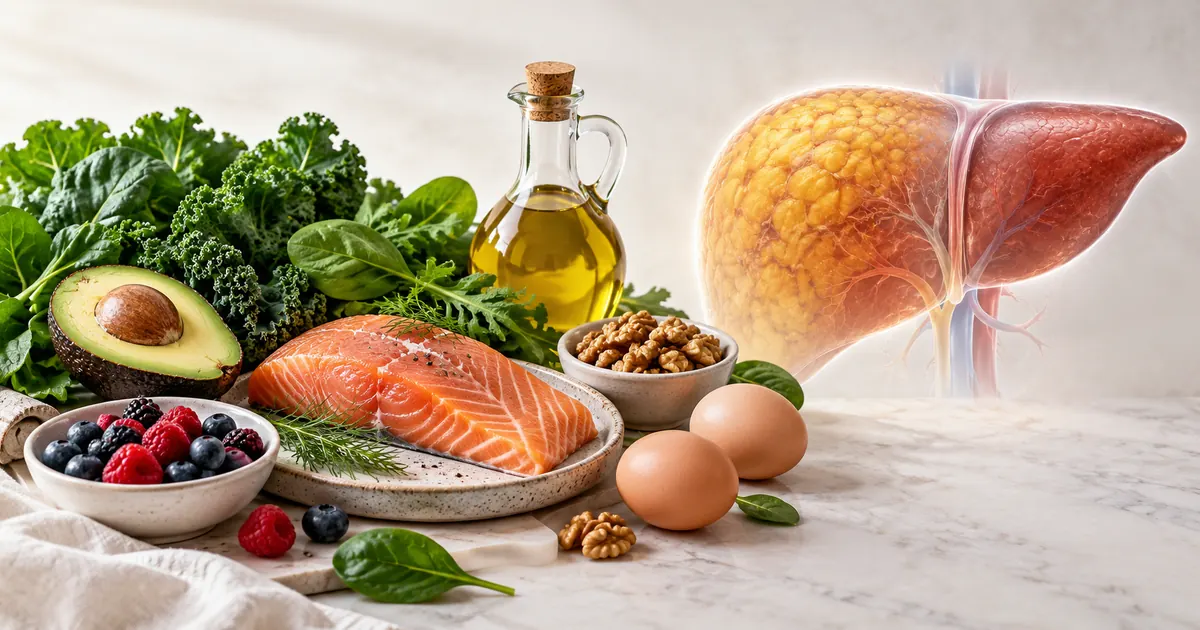
A tightly controlled trial found that a very-low-carbohydrate ketogenic diet reduced liver fat more than Mediterranean or very-low-fat diets when all three produced the same 10% weight loss. The result deserves attention—but it is not a universal prescription.
01 | First, What Is Fatty Liver Disease?
Metabolic dysfunction-associated steatotic liver disease, or MASLD, is the newer name for what many people still call nonalcoholic fatty liver disease. It describes excess fat in the liver together with at least one cardiometabolic risk factor, such as obesity, abnormal glucose regulation, high blood pressure, or abnormal blood lipids, when harmful alcohol intake is not the main explanation.5,6
MASLD covers a spectrum. Some people have liver fat without major injury. Others develop inflammation, progressive scarring, cirrhosis, or liver cancer. Because symptoms can be absent, risk assessment often depends on metabolic history, blood-based scores, and imaging rather than how a person feels.5,6
The practical question is not simply “Which diet wins?” It is “Which finding applies to whom, for how long, and under what level of support?”
02 | What the Trial Actually Tested
The study was designed to answer a difficult question: if people lose the same amount of weight, does the macronutrient composition of the diet change the metabolic result? Fifty-five adults aged 18 to 55 were randomized. All had obesity, prediabetes, and MRI-confirmed hepatic steatosis. Forty-two participants completed the intervention and were included in the main analysis.3
This was not a casual diet handout. The Washington University metabolic kitchen prepared all meals and snacks, participants met weekly with a dietitian, and logged adherence exceeded 95%. Testing occurred after each participant reached about 10% weight loss, which took roughly five months on average.3
03 | What Improved—and by How Much?
All three diets produced meaningful metabolic improvement. Skeletal-muscle insulin sensitivity increased by about 50% across groups, body fat fell, and liver fat declined. This is an important part of the story: the Mediterranean and very-low-fat diets were not failures.3
The ketogenic group nevertheless showed larger changes in several liver and glucose-related measures. Hepatic insulin sensitivity improved two to three times more than in the other groups. Relative liver-fat reduction was 67% with the ketogenic diet and about 45% with each comparator. Fasting glucose, insulin, and several other metabolic markers also improved more in the ketogenic group.3
The result is more nuanced than “high fat was harmless.” The ketogenic diet supplied 73% of energy from fat and 23% from saturated fat in the study menus. Over the intervention period, total cholesterol, LDL cholesterol, and apolipoprotein B did not differ significantly between groups after weight loss. That finding is reassuring within this trial, but it does not establish long-term cardiovascular safety for every ketogenic pattern or every patient.3
04 | What the Study Still Cannot Prove
The researchers explicitly noted that they could not determine whether ketosis itself was necessary, whether a less severe carbohydrate reduction could achieve similar effects, or whether the benefit would remain during weight maintenance. The study measured metabolic markers, not long-term outcomes such as cirrhosis, heart attacks, or survival.3
05 | Weight Loss Remains the Most Consistent Finding
The clearest conclusion across the three groups is that moderate weight loss improved health. NIH patient guidance notes that losing approximately 3% to 5% of body weight can reduce liver fat, while greater losses—often around 7% to 10%—may be needed to improve inflammation and fibrosis. Weight loss should be gradual; rapid loss and malnutrition can worsen liver disease.4
Major clinical guidelines therefore do not reduce MASLD treatment to a single macronutrient formula. They emphasize weight management, regular physical activity, dietary quality, management of diabetes and other cardiometabolic conditions, reduced alcohol exposure, and risk assessment for fibrosis. European guidance highlights minimally processed foods such as vegetables, fruits, legumes, nuts, olive oil, fish, and poultry within an individualized plan.5,6
06 | A Better Way to Choose a Dietary Strategy
Instead of asking which diet is universally “best,” ask which plan can be medically appropriate, nutritionally complete, and sustainable for a specific person. A useful discussion with a clinician or dietitian can include:
- Has liver fat been identified by imaging, and has fibrosis risk been assessed?
- Do I have diabetes, high LDL cholesterol, kidney disease, or medicines that could change the risk?
- Can the plan provide enough fiber, micronutrients, and a healthy balance of unsaturated and saturated fats?
- Can I follow it during work, travel, family meals, and long-term weight maintenance?
- Which measurements will show whether it is helping—weight, waist size, glucose, lipids, liver enzymes, or imaging?
A ketogenic pattern can be built from fish, eggs, nuts, seeds, olive oil, avocado, and non-starchy vegetables—or from processed meat, butter, and low-fiber packaged foods. Those versions are not nutritionally equivalent. The trial tested a specific prepared diet under professional supervision, not every menu marketed as “keto.”
07 | The Bottom Line
This controlled trial provides credible evidence that, in a selected group of adults who achieved approximately 10% weight loss, a very-low-carbohydrate ketogenic diet produced larger improvements in liver fat and hepatic insulin sensitivity than matched weight loss with Mediterranean or very-low-fat, plant-forward diets. It does not prove that everyone with fatty liver should follow keto, that the effect lasts indefinitely, or that diet quality and long-term cardiovascular risk no longer matter.
The most defensible takeaway is both less dramatic and more useful: weight loss helped across all three diets, macronutrient composition may modify the liver’s response, and choosing a strategy should combine evidence with medical context, food quality, and the ability to sustain it.
Sources
- October 27, 2026 Issue of JAMA. JAMA. 2026;336(16).
- Abbasi J. The Ketogenic Diet Improved Liver Health in Trial, But What Does That Mean in the Real World? JAMA. 2026;336(16):1396-1398. doi:10.1001/jama.2026.18718.
- Petersen MC, Smith GI, Farabi SS, et al. Effect of Diet Macronutrient Content on the Cardiometabolic Response to Weight Loss: A Randomized Clinical Trial. Cell Metab. 2026;38(10):2006-2017.e5. doi:10.1016/j.cmet.2026.07.020.
- National Institute of Diabetes and Digestive and Kidney Diseases. Treatment for NAFLD and NASH.
- Rinella ME, Neuschwander-Tetri BA, Siddiqui MS, et al. AASLD Practice Guidance on the Clinical Assessment and Management of Nonalcoholic Fatty Liver Disease. Hepatology. 2023;77(5):1797-1835. doi:10.1097/HEP.0000000000000323.
- European Association for the Study of the Liver, European Association for the Study of Diabetes, European Association for the Study of Obesity. Clinical Practice Guidelines on the Management of Metabolic Dysfunction-Associated Steatotic Liver Disease. Obes Facts. 2024;17(4):374-444. doi:10.1159/000539371.
Medical disclaimer: This article is for general educational purposes and is not a diagnosis or a personalized diet plan. Do not start a ketogenic diet, stop medication, or make major changes to diabetes or liver-disease management solely because of this article. Seek individualized advice from a qualified healthcare professional.